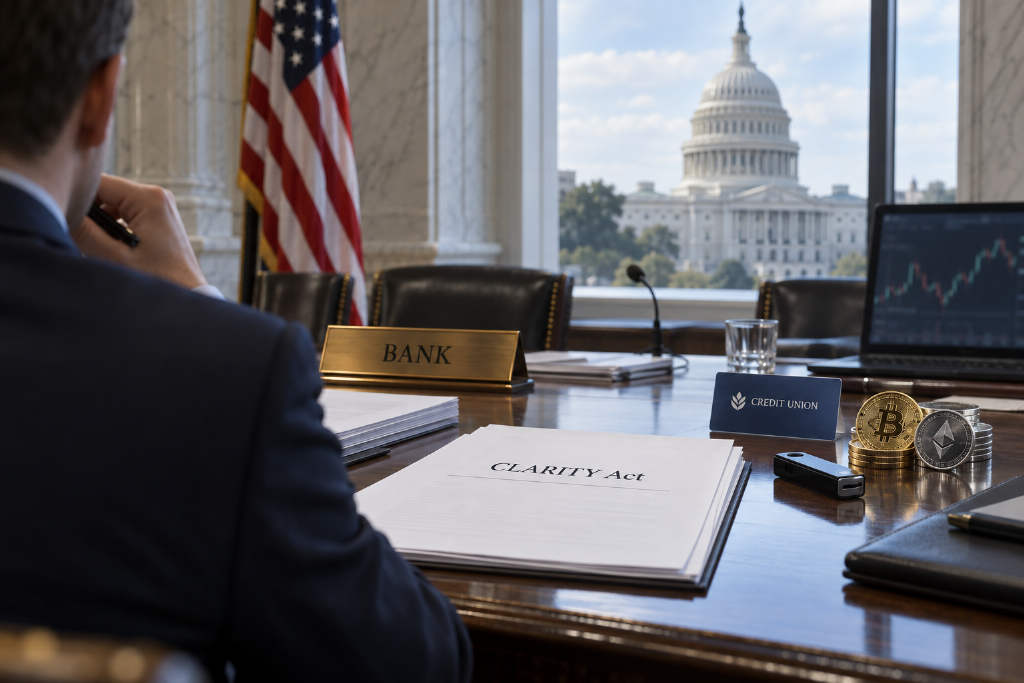
Congressional2026-10-01 18:49:57Congressional Research Service says CLARITY bill would permit 11 crypto activities for banksThe Congressional Research Service has released an analysis outlining 11 categories of crypto-related activities that U.S. banking institutions and credit unions would be allowed to conduct under the CLARITY Act, a bill that has already been introduced in the Senate. The list includes digital asset underwriting and trading, according to the report cited by Techub News. The document was prepared as a reference for lawmakers and explains how the legislation, if passed, would give traditional financial institutions a clearer legal framework for taking part in the crypto market. Crypto.news also referenced the report. The update points to a policy discussion centered on how existing banking entities could engage with digital assets under a more defined federal structure.70
tokenized dep2026-08-29 10:44:06Tokenized Deposits Could Cut US Bank Lending by $580 BillionA research paper published August 25 warns that widespread adoption of tokenized deposits could reduce US bank lending capacity by $580 billion, roughly 5% of total bank loans. Instant on-chain transfers erode deposit stability under fractional reserve banking, forcing banks to hold more liquidity and lend less. LayerZero and Keeta launched tokenized deposit products covering nine fiat currencies in July 2026, while the Bank of England and South Korea have signaled support.890
tokenized dep2026-08-28 07:06:28Report says tokenized deposits could cut U.S. banks' lending capacity by $580 billionA research report released on Aug. 25 said widespread adoption of tokenized deposits could materially reduce the long-term lending capacity of U.S. banks, with the estimated impact reaching about $580 billion. The report argues that tokenized deposits allow funds to move on a near real-time basis, which may weaken deposit stability across the banking system. That shift, in turn, could affect banks' ability to extend long-term credit. The potential effect has drawn attention from regulators and the banking industry, which are increasingly watching the risks tied to emerging financial technologies. The item was cited by Techub News and attributed to Crypto.news.860
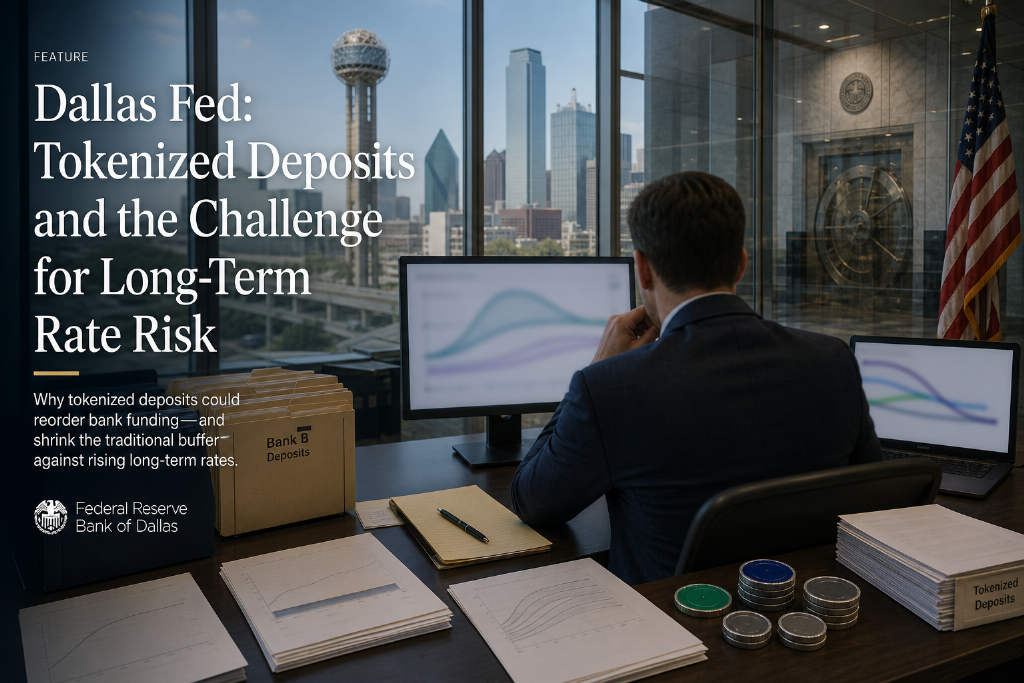
Policy and Re2026-08-26 11:50:45Dallas Fed economists say tokenized deposits could curb US banks’ capacity for long-term rate riskCoinDesk reported that two economists at the Federal Reserve Bank of Dallas modeled how tokenized deposits could affect US banks’ ability to absorb long-term interest-rate risk. In one scenario, if tokenized deposits make depositors 10% more sensitive to interest rates, US banks’ capacity to hold long-term rate risk could fall by about $700 billion. In a second scenario, if tokenization causes 10% of deposits to leave banks earlier, banks’ capacity to absorb interest-rate risk tied to long-term loans and securities could drop by about $580 billion. The estimates outline how changes in depositor behavior, rather than a direct balance-sheet shock alone, may alter banks’ role in carrying duration risk.870
tokenized dep2026-08-26 11:53:10Dallas Fed economists say tokenized deposits could weaken US banks’ capacity to absorb rate riskEconomists Rosie Levy and Srini Ramaswamy at the Federal Reserve Bank of Dallas estimate that tokenized deposits could materially reduce how much long-term interest rate risk US banks can bear under two stress assumptions. In their estimate, a 10% increase in depositor sensitivity to interest rates could reduce that capacity by about $700 billion. If tokenization were to trigger a 10% early outflow of deposits, banks would lose roughly $580 billion of risk absorption capacity. The analysis describes tokenized deposits as commercial bank money placed on blockchain rails, enabling programmable payments and real-time settlement. At the same time, the economists say smart contracts and AI agents could automate deposit shifts, cutting into deposit stickiness. They add that banks could respond by raising deposit rates, holding more reserves and Treasuries, or relying more on term debt, though those adjustments may increase borrowing costs for households and businesses. The piece also points to research on Brazil’s Pix instant payment network, which found that more frequent use was associated with higher bank holdings of liquid assets such as government bonds and less credit intermediation. Tokenized deposits remain at an early stage, with The Clearing House, Bank of America, Citigroup, and Wells Fargo among those developing interoperable networks for interbank clearing, automated workflows, and 24/7 settlement.870
US banks2026-07-24 09:10:15Major US Banks Eye Lawsuit Against OCC Over Crypto Trust Charter RulesThe Bank Policy Institute (BPI), representing JPMorgan, Goldman Sachs, Citigroup and 37 other top lenders, is considering suing the OCC over eased crypto trust charter rules. Banks warn the move blurs lines between regulated banks and lightly supervised fintechs, risking financial stability.230
tokenized dep2026-07-24 09:00:16Major U.S. Banks Target 2027 Launch for Shared Tokenized Deposit NetworkJPMorgan, Bank of America, Citi, Wells Fargo and others are working on a shared tokenized deposit network for the first half of 2027, aiming to enable instant transfers and continuous settlement for institutional users.680
CLARITY Act2026-07-23 17:10:15Banks Push Back on Stablecoin Yield as US CLARITY Act StallsBanks are pressing lawmakers to remove stablecoin yield provisions from the CLARITY Act, while legal uncertainty keeps major US lenders from committing to digital payment infrastructure.1860